
A roof underlay: is it really necessary?
When is the best time to install a roof underlay? What is it? Is it true that you need to remove your roof tiles for this? We cover all these topics in our blog post.

What is a roof underlay?
A roof underlay is a protective layer placed between the insulation and the roof tiles. This way, your house is protected against wind, dust, and dirt from the outside.
Is a roof underlay waterproof?
Many customers wonder if a roof underlay is waterproof. On the internet, you read contradictory things or people even contradict the actual purpose. If you work with quality materials, a roof underlay is guaranteed to be waterproof. This allows the roofer to afford to leave the roofing open for even a few months. It protects against the weather from outside. A modern roof underlay should therefore be windproof, waterproof, and dustproof.
On the inside, it should be vapor-permeable. This way, moisture that is still in the insulation layer can evaporate outside.
We compare a roof underlay to a Gore-Tex jacket. These are excellent jackets to face the ski slopes completely wind- and waterproof. Yet, you have the feeling that after intense efforts, you can still breathe and you're not soaking wet from your own sweat. That comparison is spot on if you want to understand the function of such a protective layer.
Is a roof underlay mandatory?
No, but it's not a step you want to skip. In the past, people only worked with natural materials. A roof then consisted of a wooden structure with the roof tiles attached to it. Fortunately, this has evolved, and we can now place a protective layer in plastic. To refer briefly to what we just wrote about the function of a roof underlay, that explains why there are so many dust, moisture, and mold problems in older houses. That the insulation of older houses often leaves much to be desired is no news under the sun. It is not for nothing that our government wants to tackle the outdated housing stock as part of climate action plans. read also: Is it wise to borrow to renovate my roof?
In older houses, the attic was designed to be directly under the roof. If you can see the roof tiles, you know that no roof underlay has been installed. If you do see some kind of foil or panels, then there is a roof underlay. Then you have the chance to check if it is damaged or contains asbestos.
The attic has since acquired other functions, causing many residents to finish it from the inside with Gyproc or wood. Thus transforming it into a storage room or extra room. As a result, you can no longer determine whether there is a roof underlay or check its condition. We can only tell, in many homes, whether the roof underlay needs to be installed or replaced when we remove the roofing.
Do you need to remove your roof tiles first?
Technically, that is possible. Then a roof underlay is placed on the inside of the rafters or the warm side of the roof. However, this is not a sustainable solution. The costs you temporarily save will eventually have to be made. Moreover, you risk having to replace the insulation again. You have no guarantee of moisture protection for your insulation and roof in the long term. We want to offer our customers sustainable solutions and will therefore only install a roof underlay on the outside.
How is a roof underlay installed?
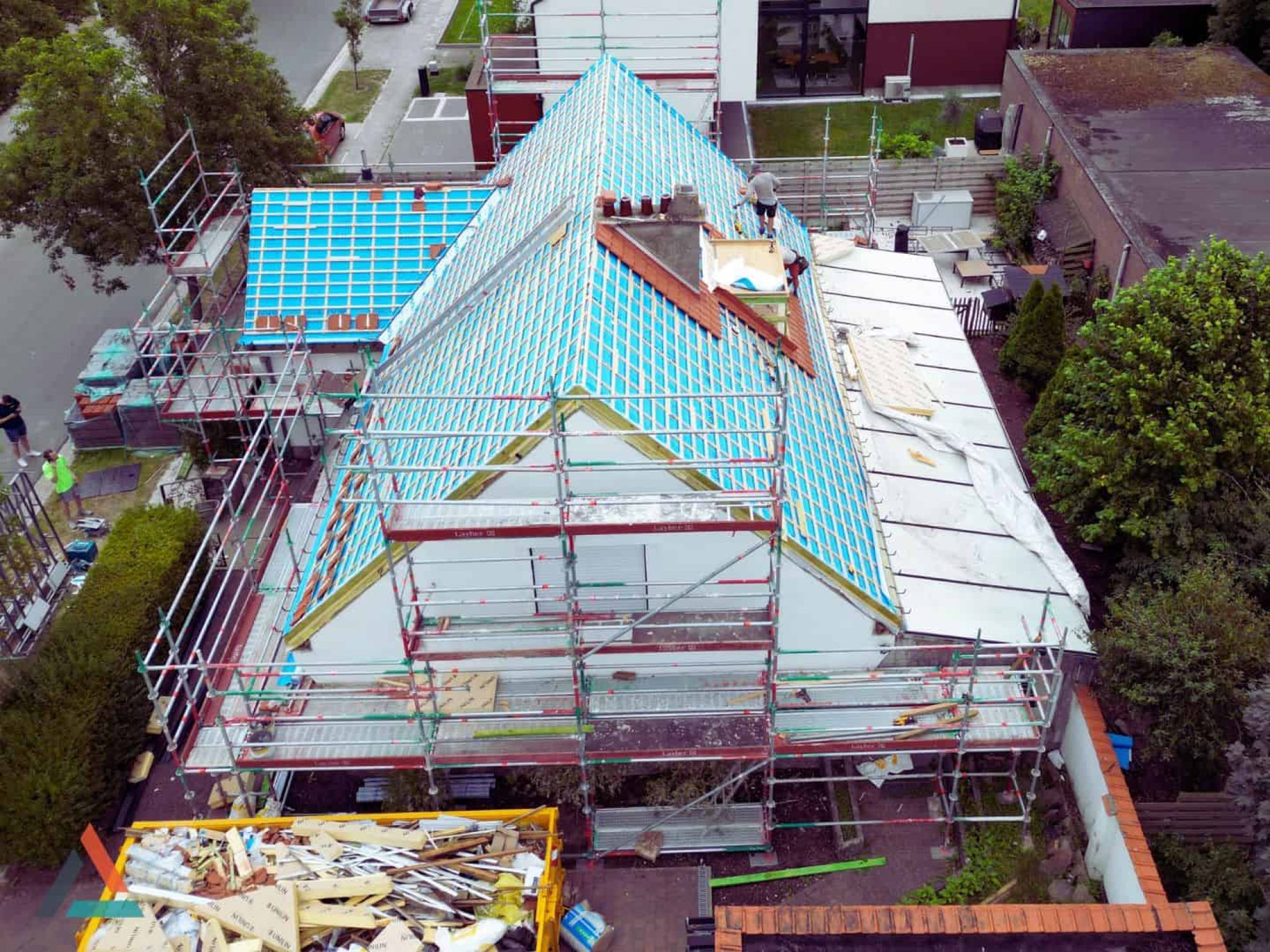
A roof underlay is placed as close as possible to the insulation. This way, we avoid air circulation. Still air acts as an insulator in itself. Often you see battens or tile battens when the roof is open. That is a rafter or truss roof. This acts as a carrier for the roof underlay and the insulation. As soon as the roofing is removed, we install the roof underlay. This way, the residents are immediately protected against the weather conditions. Even with open roofing. The roof underlay looks like strips, with an adhesive strip on the sides. That adhesive strip makes the roof underlay completely windproof. The flatter the roof, the more overlap is provided. Water on a flat roof runs off less quickly. The overlap is a grateful, extra protective layer.
The roof underlay is placed on the cold side of the insulation layer. That is the outside of the insulation layer. A roof underlay and a vapor barrier are not the same. A vapor barrier is used to protect the insulation against evaporation that occurs during household activities or from the inside. A roof underlay protects against outside air and moisture that could penetrate from outside.
Koramic Fleece range
A roof underlay can consist of rigid panels, semi-rigid panels, or a flexible film. Due to the price and ease of installation, we ourselves prefer the Koramic fleece films. Price versus quality, they are unbeatable, and it ensures that we can quickly protect our customer's home against the weather conditions. Looking at the parameters windproof, waterproof, and dustproof, there is no underlay board that guarantees us better thermal protection. Often you still have to glue the panels together with an adhesive film to guarantee that the underlay is windproof. Another advantage of working with films is that they are easy to adjust to the size of roofs or applicable to roofs with many corners and edges.
We work with both the Koramic Fleece and the Fleece Plus and the Fleece Premium. Especially in combination with our favorite Koramic roof tiles, they help ensure that you are entitled to a 30-year warranty.
The Fleece Maxi is used for roof coverings with reclaimed roof tiles or roof coverings that let in more UV. This does not apply to us. The Fleece Premium is used for roofs with gentler slopes. For the other roofs, we work with the Fleece or the Fleece Plus. The Fleece Plus has an even higher vapor permeability.
The choice for a specific roof underlay is not determined just in advance. It is the combination of the type of roof tiles and the slope of the roof that will determine which Fleece we advise.
If you have any questions or would like specific information, you are welcome to contact us. Of course, you can also make an appointment for non-binding advice. We are happy to share our knowledge, tips, and tricks with you.


You might also find this interesting?

2 March 2026
Press Release Huis Gemaakt

27 December 2023
Asbestos on your roof: how to tackle it safely

27 December 2023